Entry 000 · Case One
Read Case
The Borrowed Face Case
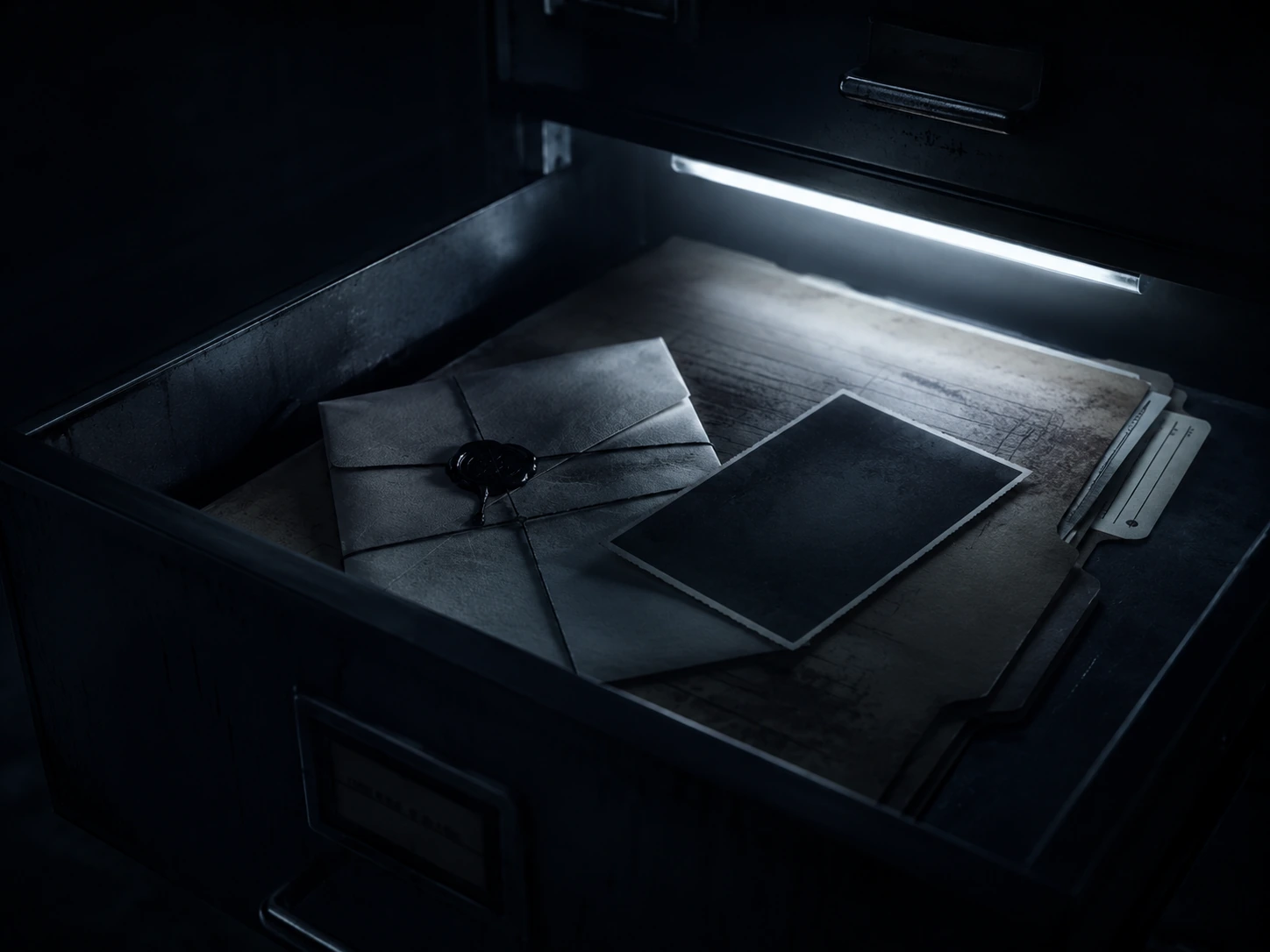
The opening file in the Borrowed Face Archive: the first report, the first impossible description, and the first envelope marked with the black-thread seal.
A continuing horror investigation told as article entries. The cases share one dark archive: faces that do not stay owned, records that change after filing, and evidence that arrives after closing.
Entry 001 belongs to the separate You’re Late book file and remains closed. The Borrowed Face Archive begins with Entry 000 and continues with Entry 002.
The opening file in the Borrowed Face Archive: the first report, the first impossible description, and the first envelope marked with the black-thread seal.
The archive widens when a removed phone booth, a brass bell, and the same black-thread seal appear beneath Marrow Street.
The archive confirms its pattern through class photographs, altered records, and a back-row figure appearing beside students who died before graduation.
The murder pattern becomes undeniable when a morgue ledger lists bodies under the wrong names, and some listed victims are still alive.
The archive reaches into bloodlines, forcing Mara to confront a sister her family paid to forget.
A courthouse room begins filing evidence by itself, and Mara discovers her own name already in custody.
Twenty-six impossible callers sing the same alibi, protecting a death that has not happened yet.
The missing first file surfaces inside Drawer Nine, proving the archive has been waiting for Mara all along.
The first major turn arrives: the case produces a bill for Mara’s name, and Entry 001 starts opening from the inside.
Iris receives the black-thread envelope meant for her future face, and Mara realizes the archive is not just recording victims anymore. It is scheduling them.
Mara and Iris return to the old foster home file, where the first body in the archive refuses to stay dead in the paperwork.
The impossible room beneath Mara’s own name opens, and the case shifts from investigation to inheritance.
Mara confronts the record of her mother’s bargain, but the archive reveals the witness statement was given twice: once before the murder, once after.
Iris performs the autopsy she avoided years ago, and the body begins naming the living people who helped the Facekeeper build the archive.
A hidden language of bones reveals how the Facekeeper catalogs victims, and Mara learns the archive has been spelling a message through every case file.
Mara enters her childhood home, where every room has erased Elise except the one place that still remembers her screaming.
A photograph develops the wrong version of Mara: the detective who never survived, and the sister who did.
A forgotten clerk appears in every Venn family photograph, proving the archive had a human witness inside the house long before the fire.
The impossible callers from Entry 011 turn against one another, and their broken alibi names the person who invited the Facekeeper into Mara’s house.
The town’s hidden shrine to the Facekeeper reveals why so many adults chose the archive, and why victims kept wearing borrowed faces after death.
The final door before the first body appears wearing Elise’s face, forcing Mara to choose between rescue and recognition.
Entry 026 opens the beginning: the first body, the first bargain, and the first proof that Elise may not be the victim Mara thought she was.
The envelopes arrived at different times. The records changed in different rooms. The photographs came from different hands.
But the mark is the same: black thread, wrong face, one archive.
Case One now follows a murder pattern through faces, rooms, and stolen interiors inside the Borrowed Face Archive, without touching the books kept behind the shelf.